What a supply pipe is, and which part you own
Two pipes bring water from the street to your kitchen tap. One of them is your water company's. The other one is yours, and it is the one that costs money when it leaks.
0333 567 2637Seven days a week, 7am to 9pm. Fixed price agreed before anyone travels.
The five parts, and who looks after each one
Your water company looks after thisYou own this
The water main Water company
The public pipe under the road. Everything from here to your boundary is theirs to maintain and repair.
The communication pipe Water company
The short spur that branches off the main and runs as far as your boundary.
Boundary stop tap and meter Water company
The chamber under the small metal or plastic lid at the edge of your property. The stop tap inside it shuts your supply off at the boundary, and on a metered property the meter usually sits alongside it.
The supply pipe Yours
From the boundary to your house, buried under whatever is on top of it. This pipe belongs to the property owner. A leak on it is yours to find and yours to fix.
The internal stop tap Yours
Usually under the kitchen sink. Shutting this isolates the plumbing inside the house, which is what makes it the fastest way to tell an inside leak from an outside one.
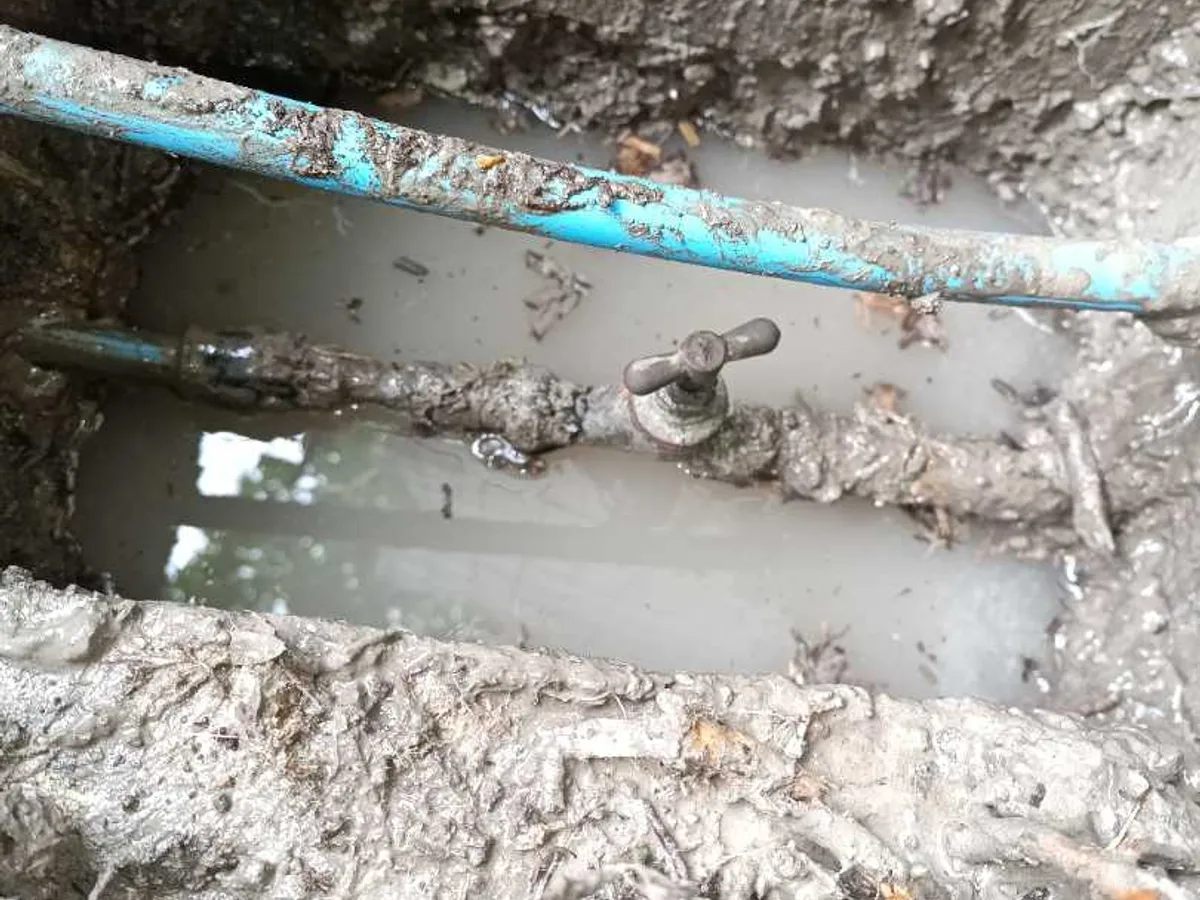
And here is one out of the ground
Blue plastic, a stop valve on it, and the trench filling with the water it has been losing. This is the same pipe the drawing calls number four, on an ADI job where the loss turned out to be at the valve rather than along the run.
Where the line is drawn
The boundary is the dividing line, and in most cases it runs along the edge of the property at the pavement. Up to that point the pipework belongs to the water company and is repaired by them. Past it, the pipe is part of the property, and the owner carries the cost of finding a leak and putting it right.
That single fact is behind most of the confusion on the phone. A householder sees a meter in a chamber at the front of the property, assumes anything near it must be the water company's, and loses several weeks waiting for somebody else to come and fix it. The chamber usually is theirs. The pipe leaving it is not.
The exceptions worth knowing
A supply pipe that serves more than one property is normally the joint responsibility of the owners it serves, and the repair cost is shared between them. Older terraces are full of these, and the person who notices the leak is rarely the person the pipe was named after.
Some properties have no internal stop tap at all, which removes the fastest test available and means the supply has to be shut off at the boundary instead. On an ADI job at Marlborough the first hour went on locating the isolation points, because the house flooding its own basement could not be shut down from inside.
How it should have been laid
The Water Supply (Water Fittings) Regulations 1999 require a supply pipe to sit at least 750 mm below ground level and no more than 1,350 mm. Below the frost line, in other words, but still shallow enough to reach. A pipe laid too high is the one that fails in a hard winter. A pipe laid too deep turns a half day repair into an excavation.
What your supply pipe is probably made of
The material sets how the pipe fails, how easy it is to hear, and whether a repair is worth doing at all. The age of the house is the best clue you have before anyone digs.
| Material | Typical era | How it behaves |
|---|---|---|
| Blue MDPE | Roughly 1990 onwards | The current standard. Medium density polyethylene, flexible, does not corrode. Normally 25 mm on a single house. Fails at joints, at damage points and where it has been laid over something sharp. |
| Black alkathene | Roughly 1950 to 1990 | An early polyethylene, usually black. It goes brittle with age and splits, often along a length rather than at one point. |
| Lead | Pre 1970, still common | Soft, easily damaged by ground movement and vibration, and near the end of its service life anywhere it survives. A lead run that has leaked once tends to leak again. |
| Copper | Various | Found on shorter runs and on the section entering the building. Corrodes in aggressive soil and pinholes rather than bursting. |
| Galvanised steel | Older properties | Rusts from the inside, which narrows the bore and weakens the wall at the same time. Usually replaced rather than repaired. |
Why supply pipes fail, and which failures give warning first
Whose pipe is it
Six questions about responsibility, answered without reference to a particular supplier.
Who is responsible for the supply pipe?
The property owner normally maintains the private supply pipe; the water company maintains its main and communication pipe. The boundary is a useful guide, but the exact arrangement can differ, especially where pipes cross other land. Ask your supplier to confirm responsibility.
If you rent, report the problem to your landlord or managing agent before arranging work. If the leak is on the water company’s pipe, report it to them.
Guidance: Scottish Water customer leakage guidance; Thames Water household leakage guidance.
What if the supply pipe is shared?
Owners are normally jointly responsible for the shared section. A branch serving only one property is normally that owner’s responsibility. Confirm the pipe arrangement and any agreements before deciding how repair costs should be split.
Tell us before booking: access to other properties may be needed for testing.
Guidance: Thames Water household leakage guidance; ADI full booking terms.
What should I do with a water company leak notice?
Contact the company promptly and follow the deadline and instructions in your notice. Ask what help is available and tell them if access or repair arrangements are causing a delay.
In England and Wales, a water company can use section 75 of the Water Industry Act 1991 to require action and may recover costs if it has to undertake work. Scotland has a separate legal framework. Do not assume the same notice period applies everywhere.
Guidance: Thames Water household leakage guidance; Scottish Water customer leakage guidance.
Not sure which side of the boundary it is on
Describe what the meter does with the internal stop tap closed and we will tell you what we think it is before anyone travels. Seven days a week, 7am to 9pm.
The office team speak to every customer before an engineer is booked, and the engineer who attends is the one who writes the report.
Seven days a week, 7am to 9pm
England, Scotland and Wales. £5 million public liability insurance.